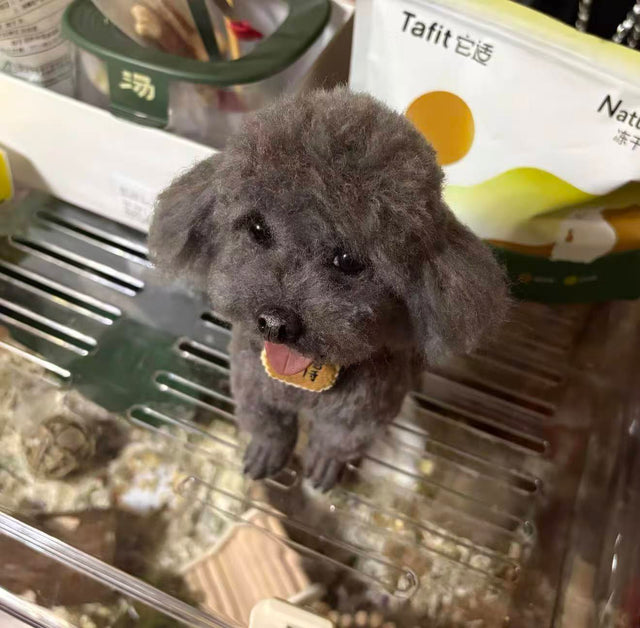
A needle felted pet keepsake is made from wool, and wool behaves differently from ceramic, resin, or a framed photograph. It does not chip or crack. What it does need protection from is moisture, direct sun, careless handling, and one risk most owners never think about until it is too late: moths.
The good news is that wool is remarkably durable when treated properly. Textile pieces in museum collections survive for centuries. Your sculpture only needs a fraction of that care to stay looking the way it did the day it arrived.
Here is what actually matters, in order of how likely it is to cause damage.
Quick Reference
| Do | Do not |
|---|---|
| Dust with a soft brush every few weeks | Never wash, soak, or spot-clean with water |
| Display out of direct sunlight | Do not place near humidifiers or in bathrooms |
| Trim stray fibers with small scissors | Never pull loose fibers |
| Keep out of reach of real pets | Do not treat it as a toy |
| Store sealed if putting away long-term | Do not store in a damp basement or hot attic |
Never Use Water
This is the one rule with no exceptions. Wool fibers in a needle felted piece are held together by mechanical entanglement, not glue. Water combined with agitation causes wool to felt further and shrink unevenly, which permanently distorts the shape you paid for.
That means no washing, no soaking, no damp cloth, no steam, and no cleaning sprays. If your sculpture picks up a mark, resist the instinct to wipe it. Contact us first and describe what happened.
If the piece somehow gets wet, blot gently with a dry towel and let it air dry away from heat. Do not use a hairdryer on a warm setting, and do not put it near a radiator.
Dust It Gently, Regularly

Dust is the most common reason a wool sculpture starts to look dull. It settles into the fiber surface and flattens the texture that makes the piece look like fur.
Use a soft makeup brush or a clean, soft paintbrush. Brush lightly in the direction the fur lies, not against it. A can of compressed air held at a distance works for tight areas around the face and paws. A hairdryer on the cool, lowest setting is also fine.
Do this every few weeks rather than waiting for visible dust to build up. It takes under a minute and prevents the gradual dulling that is much harder to reverse.
For a framed portrait behind glass, dust the glass normally and leave the wool untouched.
Keep It Out of Direct Sunlight
Wool dyes fade under ultraviolet light. A sculpture sitting in a sunny window will lose color depth over months, and the fading is uneven — the side facing the window goes first, which is more noticeable than uniform fading.
Indirect natural light is fine. A shelf across the room from a window, a bookcase, or a mantel away from direct sun will all work. If the only good display spot gets strong afternoon sun, consider a glass dome with UV-filtering properties, or simply rotate the piece occasionally so no single side takes all the exposure.
Protect It From Moths
This is the risk almost nobody warns you about, and it is the one that can destroy a wool piece completely rather than just wear it down.
Clothes moths do not eat wool as adults. Their larvae do. The larvae feed on keratin, the protein in wool, hair, and feathers, and a needle felted sculpture is essentially a solid block of exactly what they want. According to the Canadian Conservation Institute, clothes moths are among the major insect pests affecting museum collections precisely because of this.
What makes them dangerous is that the damage happens out of sight. Adult moths seek dark, undisturbed places to lay eggs. A sculpture on an open shelf that you dust regularly is at low risk. A sculpture in a closed cabinet you never open, or packed away in a closet, is at much higher risk.
Practical prevention:
- Keep the piece in a room you actually use, in reasonably dry air
- Do not seal it away in a dark cupboard for years without checking
- Dust and inspect it periodically — regular disturbance alone discourages moths
- Watch for the warning signs: fine silky webbing, small grainy debris that looks like sand, or thin bare patches in the wool
If you find an active infestation, the conservation-standard response is freezing. The Canadian Conservation Institute specifies that low-temperature treatment requires either several days at −30°C or about a week at a daytime high of −20°C to be reliable, and that the object must be sealed in vapour-resistant bagging that stays on through the entire re-warming phase — otherwise condensation forms on the piece as it returns to room temperature.
A domestic freezer typically runs around −18°C, which is at the edge of that range and not guaranteed. If you suspect moths, contact us before attempting any treatment.
Handle It Sparingly

Your sculpture is a display piece, not a plush toy. The distinction matters most for the fine details: whiskers, ear tips, tail shape, and the fur direction around the face are all held by fiber tension that repeated handling gradually loosens.
Pick it up by the body or base rather than by the head, legs, or tail. If you have young children, place it above their reach.
If you specifically wanted something that can be held and hugged, a plush pet replica is built for that and tolerates handling far better than a felted sculpture does.
Keep It Away From Your Actual Pets
Cats and dogs are drawn to wool because it smells like a natural animal fiber. To them, a needle felted sculpture reads as something interesting rather than something fragile.
Display it high, behind glass, or in a room your pets do not have unsupervised access to. This is worth taking seriously — it is one of the more common ways these pieces get damaged.
Managing Loose Fibers
Over time a few loose fibers may work their way to the surface. This is normal for hand-felted wool and is not a defect.
Trim them with small sharp scissors. Never pull them. Pulling a fiber can drag connected fibers out of the felted structure and leave a visible dent or thin patch. Snipping close to the surface removes the stray hair and leaves the structure intact.
Long-Term Storage

If you need to put the piece away — moving house, redecorating, or storing a memorial piece for a period — a few precautions prevent most damage:
- Wrap in acid-free tissue paper rather than newspaper, which transfers ink and acidity
- Place in a rigid box so nothing compresses the shape
- Seal the box against moths
- Store somewhere dry with a stable temperature: a closet inside the house, not a basement, garage, or attic
- Do not stack anything heavy on top
- Check it once or twice a year
One caution on sealing: only bag a piece that is already dry. The Canadian Conservation Institute warns against sealing objects that have equilibrated above 65% relative humidity, because you trap moisture at a level that can eventually support mould growth. If you live somewhere humid, let the piece acclimatize in a dry indoor room before boxing it up.
What Normal Aging Looks Like
Some changes are not damage:
- Very slight softening of surface texture over years
- A few loose fibers appearing periodically
- Minor settling in a large sculpture's pose
These are characteristics of handmade wool, and they are part of why a felted piece looks different from a manufactured one. What is not normal: bald patches, webbing, grainy debris, visible distortion of the shape, or a musty smell. Any of those warrant a closer look.
Questions About Your Piece
If something happens to your sculpture — a spill, an accident, a suspected pest problem, or anything that just looks wrong — get in touch before attempting a repair. Wool is forgiving if handled correctly and easy to make worse with the wrong approach.
Email: felixharrison.trade@gmail.com WhatsApp: +86 180 3291 8577
We reply within 2 business days.
Related Reading
- How a needle felted pet portrait is made — the process behind the piece
- Needle felted vs plush pet replica — which format suits your situation
- How much does a needle felted pet portrait cost — 2026 price guide
Browse custom cats, custom dogs, or all custom pet keepsakes.