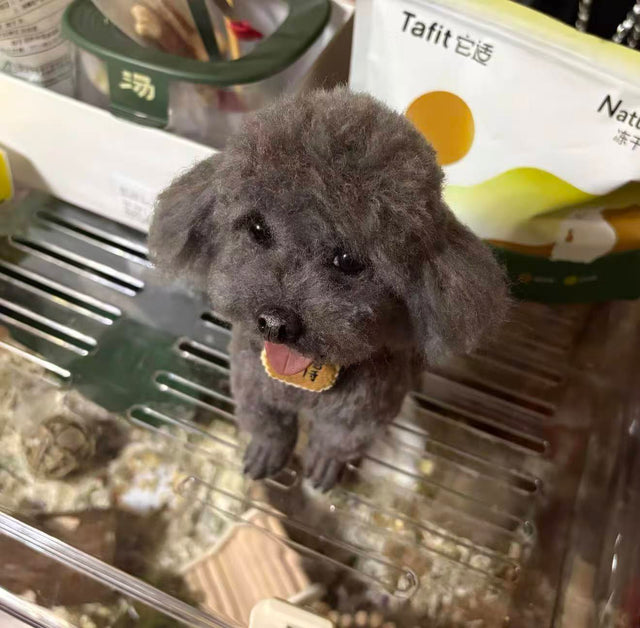
Short answer: Send five to eight clear photos: one straight-on face shot, one from each side, one full-body shot if you are ordering a sculpture, and close-ups of any markings that make your pet look like your pet. Shoot them in daylight, at your pet's eye level, from about two metres away. Phone photos are fine — professional photography is not needed.
That is the checklist. The rest of this guide explains how to take those photos, what makes a reference photo fail, and what to do if your pet has already passed away and you only have what is on your phone.

Why the photos matter more than anything else you choose
When you order a custom pet portrait, you pick a size, a format, maybe a frame colour. Those decisions take five minutes. The photos you attach decide almost everything else.
A wool portrait is built from information. The artist cannot ask your dog to turn his head. Every detail that ends up in the finished piece — the exact width of the muzzle, the way one ear folds, the point where the tan fades into cream — has to be visible in something you sent. Where the photos are vague, the artist has to guess, and a guess is what turns a portrait into "a nice dog" instead of "him".
This is also the one part of the process entirely in your hands. So it is worth twenty minutes.
The five-photo core set
Start here. If you send nothing else, send these.
1. Straight-on face, at eye level
The single most important photo. Crouch until your camera is level with your pet's eyes — not above them. A photo taken from standing height shortens the muzzle and enlarges the forehead, and a portrait built from it will look subtly wrong in a way that is hard to name.
2. Left profile
Shows muzzle length, forehead slope, and ear set. These are the measurements that make a breed look like a breed and an individual look like an individual.
3. Right profile
Not redundant. Most animals are asymmetrical — a marking that stops short on one cheek, an ear that sits lower. Send both sides and the artist can build the real animal rather than a mirrored one.

4. Full body, standing, side on
Essential if you are ordering a sculpture rather than a framed portrait. Shows proportion — leg length against body depth, chest width, tail carriage, how the animal actually holds itself.
5. Your favourite photo
Not a technical shot. The one that looks like them. Tell us this is the one and the artist will work toward that expression.

How to actually take them
This is the part most guides skip.
Use a window, not a lamp
Indoor bulbs cast a colour tint that shifts fur tone — warm bulbs push grey toward brown, cool LEDs drain the warmth out of a ginger coat. Daylight is neutral and free.
Put your pet a metre or two from a window with the light coming from the side or slightly in front. Not backlit: if the window is behind them, the camera exposes for the bright background and your pet becomes a silhouette.
Overcast days are better than bright sun. Direct sunlight creates hard shadows across the face and blows out white fur into a featureless patch.
Stand back and zoom, don't lean in
Phone cameras use a wide lens. Held close to a face, that lens stretches whatever is nearest — the nose balloons, the ears shrink back. It is flattering on nobody.
Stand about two metres away and use 2x zoom if your phone has it. The proportions come out true.
Get low
Say it again because it is the mistake almost everyone makes: camera at your pet's eye level. Sit on the floor. For a small dog or a cat, that means lying down.
Turn the flash off
Flash flattens fur texture, kills the depth in the coat, and produces reflective eyes. Wool portraits are made of texture. Give the artist texture to look at.
No filters, no beauty mode
Portrait mode blurs edges, including fur edges. Auto-enhance shifts saturation. Send the original file, unedited — and send the full-resolution version, not a screenshot or a compressed messaging-app copy.
Coats that need extra photos
Some pets are harder to read from a photo. If yours is one of these, send more.
Black or very dark coats. Detail disappears into shadow. Photograph in bright indirect daylight and take several exposures, including one that looks slightly too bright — that overexposed frame is often the only one where the artist can see the actual structure of the face.
Long or double coats. Fur direction matters as much as colour. Add close-ups of the ruff, the tail, and the feathering behind the legs.
Multi-coloured or patched coats. Photograph each distinct patch. Where exactly does the white stop on the chest? Is the mask symmetrical? These borders are what the eye recognises.
Wiry and curly coats. Send a close-up from about 30 cm so the artist can see how the individual curls sit.

What makes a reference photo unusable
In rough order of how often we see it:
| Problem | Why it breaks the portrait |
|---|---|
| Screenshot or social-media download | Resolution is already destroyed; zooming in shows blocks, not fur |
| Backlit against a window | Face is a dark shape with no readable detail |
| Taken from above | Distorts head-to-muzzle proportion |
| Heavy filter or beauty mode | Coat colour is no longer the real colour |
| Motion blur | Edges are soft, so markings have no clear border |
| Only one photo, face-on | No profile data — the artist has to invent the side of the head |
If you are unsure whether your photos are good enough, send them and ask before ordering. We would rather look first than have you wait weeks for something built on thin information.
If your pet has already passed away
This is the situation the checklists above quietly ignore, and it is a large share of the portraits we make.
You cannot go and take new photos. What you have is what exists. So the rules change:
Send everything, not just the best few. Ten mediocre photos often contain more usable information than one good one. A blurry photo can still confirm ear shape. A dark photo can still confirm where a marking ends.
Old prints work. Photograph the print flat in daylight, no flash, camera parallel to the surface so the image is not skewed.
Video is a good source. A few seconds of your dog walking around the garden contains dozens of angles. Send the clip; we can pull frames.
Photos with other people in them are fine. Do not discard a photo because your pet is not centred or someone's arm is in the way.
We have never turned away an order because the photos were imperfect. Fewer photos simply mean the artist spends longer studying what you have. If you want to see how that study becomes a finished piece, we documented the whole process in how a needle felted pet portrait is made, and if you are considering a memorial piece specifically, our pet memorial ideas guide covers the formats people choose.
Multiple pets
Photograph each animal separately using the full set above, even if you want them together in one piece. A photo of two dogs side by side is a composition reference, not a likeness reference — each face still needs its own straight-on and profile shots.
What happens after you send them
Once your photos are in, the artist reviews them before production begins. If something critical is missing — no profile, or the only face shot is blurred — we come back and ask rather than guessing.
From confirmed photos, production takes 3 to 5 weeks. Every piece is made by hand, one at a time.
Before anything ships, we photograph and film the finished piece and send it to you for approval. If a marking is wrong or the expression is not quite right, that is the moment to say so, and we adjust. Nothing leaves the studio until you have said yes.
Shipping after approval runs 7–12 business days to the United States and Canada, 8–14 to the UK and Europe, 10–15 to Australia and New Zealand, and 12–20 to the rest of the world. Shipping is free on most custom pet replicas.
Which format needs which photos
| Format | Price | Photos that matter most |
|---|---|---|
| Framed 3D wool portrait | $289–339 | Face-on, both profiles, close-ups of facial markings |
| Framed cat portrait | $299–359 | Same, plus eye colour in daylight |
| Full-body sculpture | $699–799 | Everything above, plus full body from both sides and standing pose |
| Plush replica | $299–399 | Face-on, profiles, full body, coat close-ups |
| Keychain or car charm | $59–65 | One clear face-on photo is usually enough |
Detail level scales with size. A keychain reads at arm's length; a full-body sculpture is examined closely from every angle, which is why it needs the fullest photo set.
If you are still deciding between formats, needle felted vs plush pet replica compares how each one handles likeness, and what a needle felted pet portrait costs breaks down what drives the price.
A twenty-minute checklist
Before you order:
- Wait for daylight. Overcast is ideal.
- Position your pet near a window, light from the side or front.
- Sit on the floor, camera at their eye level.
- Step back two metres, zoom to 2x, flash off, filters off.
- Take the five core shots: face-on, left, right, full body, favourite.
- Add close-ups of every distinctive marking.
- Send full-resolution originals, not screenshots.
- Say which photo shows the expression you want.
Not sure your set is strong enough? Send it to our Customer Care Team on WhatsApp at +86 180 3291 8577 or email felixharrison.trade@gmail.com and we will tell you honestly before you order. If you would like to see the whole ordering process first, How It Works walks through it step by step.
Once the piece is home, our care guide covers cleaning, storage, and long-term protection.